From the Classroom to the Panama Canal: Lessons in Global Trade, Geopolitics, and Business
First-person perspectives inspired by the Baratta Center’s 2026 Panama Trek
Every year, roughly five percent of global maritime trade passes through a narrow, 50-mile stretch of land in Panama. For students of global business, that statistic is more than a fact. It is a reminder that geography, politics, and trade are inseparable forces shaping the world economy. Preparing students to navigate this reality is central to the mission of the Baratta Center for Global Business Education, which connects students with the institutions and leaders shaping global markets through experiential programs such as the Global Business Labs (GBL).
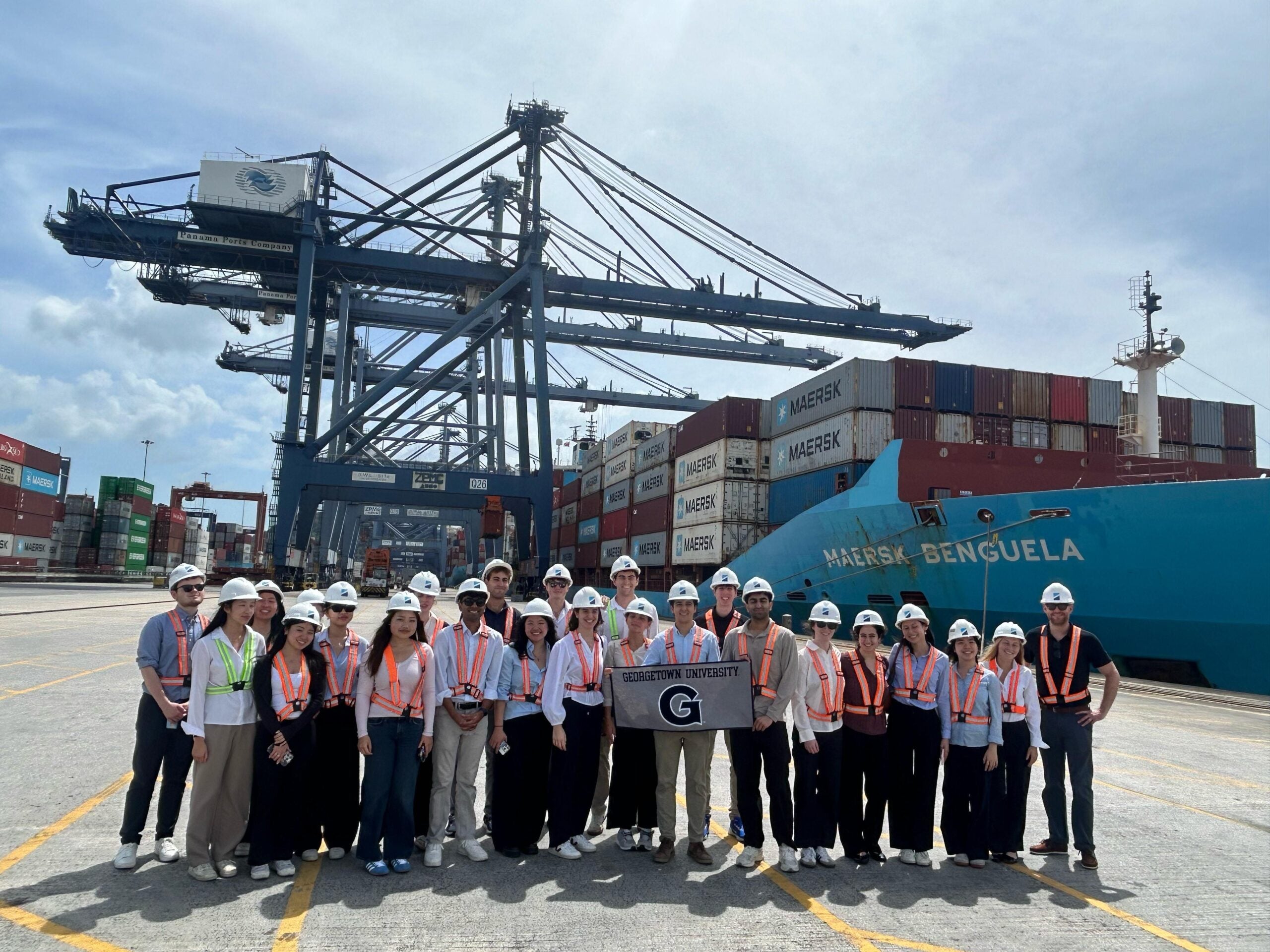
The Global Trade module was one such GBL. Students explored negotiating trade agreements, managing geopolitical risk, and navigating tariffs and global sourcing strategies through practitioner-led sessions with leaders including Luis Jiménez, former senior counselor to the U.S. Secretary of Commerce and former counselor to the U.S. Trade Representative, Laura Lane, vice president and chief corporate affairs officer at Chevron, and Andrea Albright, former executive vice president and chief growth officer at Walmart. The module culminated in Jan. 2026 when 25 Global Business Fellows (GBFs) traveled to Panama City to engage directly with one of the world’s most consequential trade corridors. As a small nation at the crossroads of domestic development and major power pressure, Panama offered an ideal setting to bring those lessons to life.
Panama’s Role in the Architecture of Global Trade
Standing at the edge of the Panama Canal, the scale and complexity of global trade suddenly felt concrete. Watching container ships move through the Miraflores Locks made clear what we had spent the semester discussing in the abstract: how a narrow strip of land can shape the flow of global commerce. For me and many of the students on the trek, the canal brought into focus how geography, politics, and trade intersect in the real world.
The Panama Canal has defined the trajectory of Panama for more than a century. Built and operated by the United States after Panama’s independence from Colombia in 1903, control of the canal transferred to Panama in 1999 under the Torrijos-Carter Treaties. During the trek, we had the opportunity to hear directly from Georgetown alumnus Samuel Lewis (B’79), the former first vice president and foreign minister of Panama. As an architect of Panama’s political-economic transition and an active player in its business community today, Lewis conveyed his confidence in Panama’s responsibility to operate the canal as a free and open trade zone that serves global trade.
At the same time, one of my biggest takeaways from the trip was that Panama’s strategy goes far beyond the canal itself. Over the past two decades, the country has built an integrated trade ecosystem, developed ports, logistics infrastructure, and a favorable regulatory environment for business. Together, these forces have drawn multinational corporations seeking a regional base in the area, and fueled Panama City’s emergence as a Latin American financial center. Copa Airlines has reinforced this identity from the air, transforming Panama City into one of Latin America’s busiest connecting hubs.
Seeing how these pieces fit together made it clear that the canal is not Panama’s only asset, but the foundation of a much broader system supporting global trade.
The Panama Canal: By the Numbers

Source: Council on Foreign Relations. “Who Controls the Panama Canal?” Jan. 29, 2025. https://www.cfr.org/articles/who-controls-panama-canal.
A Systemic View of Panama: Lessons From an Interactive Workshop
On the trek, Stephen Weymouth, director of the GBF program and professor at Georgetown McDonough, led a workshop that challenged students to analyze Panama as a system. Pre-assigned to one of five groups, students independently researched a distinct dimension of Panama’s political economy and then collaborated to produce a shared visual diagram illustrating the key themes and players. Groups presented to the full cohort and opened the floor for discussion before Professor Weymouth introduced a shock scenario designed to test the resilience of each system and its respective stakeholders.
The Panama Canal
Students identified water scarcity, infrastructure stress, capacity constraints, and exposure to global shocks as the canal’s defining pressure points: painting a picture of an asset that is indispensable to Panama’s economy, yet perpetually subject to forces beyond its control. Beyond direct canal revenues, the waterway generates economic benefits that ripple across jobs, tourism, and Panama’s broader service economy, making Panamanian stewardship of the canal not just a point of national pride, but an economic imperative.
Nicolás Bastidas (B’27) noted that this workshop “revealed the interconnectedness that trade has with the Panamanian people and every single aspect of their economy.”
Panama as a Logistics Hub
In the workshop, the logistics group examined why multinational firms choose Panama and what might drive them away. This question came to life during site visits to the regional distribution center for Skechers and the Port of Balboa, a major Pacific-side container terminal leased and operated by Hong Kong-owned Hutchison Ports. Students identified Panama’s strengths as a logistics hub — its international economy, special economic zones, natural resources, and geopolitical position — alongside weaknesses, including competition, regulatory uncertainty, environmental challenges, and geopolitical exposure. The Port of Balboa’s shift in management as of Feb. 2026 serves as a live demonstration of those ongoing vulnerabilities.
Geopolitics, Domestic Politics, and Financial Services
Students also examined geopolitical pressure, domestic politics, financial services, and tourism as interconnected layers of the same system. Geopolitics, students found, is a pressure felt across every dimension of Panama’s economy, one that Panama has sought to mitigate through its commitment to neutrality.
Rachel Wang (B’26) captured the tension well: “On one hand, Panama is able to maintain its role as a neutral, beneficial player for all countries around the world, regardless of their political standings with other countries. This, in turn, creates major challenges because of the current state of geopolitics.”
On the domestic front, the 2025 social security reform crisis — marked by strikes, road blockades, and mass protests — illustrated how quickly internal political conflict can interfere with Panama’s critical revenue-generating operations, creating an amplified feedback loop that harms Panamanians.
In financial services, students found that Panama’s dollarized economy, geographic advantage, and established business environment give it a strong foundation as a cross-border finance hub; yet, uncertain regulation, geopolitical instability, and rising competition threaten to erode that position. Tourism was identified as a sector with significant untapped potential where Panama’s biodiversity, cultural richness, and geographic position remain underleveraged relative to its regional peers, and where strategic investment could open a meaningful alternative engine of growth.
Panama’s Sectoral GDP Breakdown
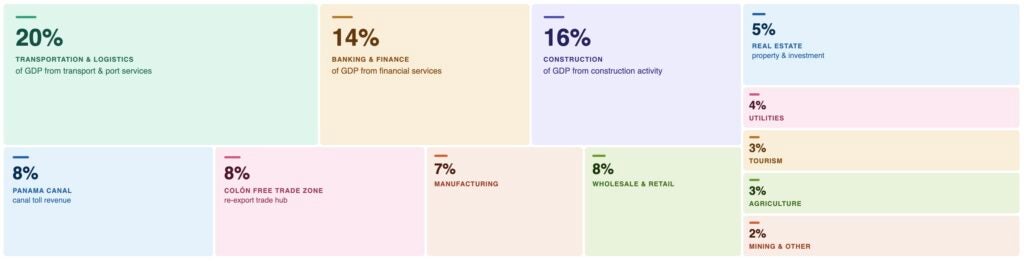
Source: World Bank national accounts data; IMF World Economic Outlook Database, Oct. 2024; Panama Canal Authority Annual Report 2023. Sector breakdowns reflect 2022–2024 estimates and may not sum to 100% due to rounding.
The Shock Scenario: Insights from Simulating System Failure
Professor Weymouth introduced the following shock simulation scenario: the U.S. government deploys troops to Panama to secure control of the canal. This scenario prompted students to examine how such a geopolitical shift could reverberate across Panama’s interconnected economic and political systems. Students considered how canal operations, trade flows, and logistics networks might adjust under changing governance while also exploring how Panama’s neutrality could be tested. The scenario raised questions about how multinational firms, financial institutions, and tourists might reassess risk and opportunity, and how domestic political actors might respond to the loss of sovereignty over a critical national asset. Ultimately, the discussion underscored that Panamanian control of the canal is central not only to its economy, but also to the stability it signals globally, raising the ongoing question of how external intervention might reshape that position.
To go beyond the student fellows’ workshop analysis, data from Harvard’s Growth Lab Metroverse tool maps Panama City’s industries against global peers, revealing both the depth of its strengths and the contours of its vulnerabilities. Trade and transportation stand out as Panama’s defining competitive advantages: being dominant in presence and a strong technological fit for the city’s productive structure. Financial activities and professional services emerge as genuine growth opportunities. Yet that same concentration is a source of fragility: an economy built around being a connector of ships, capital, and commerce is exposed when any of those flows are disrupted. Diversifying without abandoning Panama’s core identity may be the central economic challenge ahead.
Learning Beyond Observation: Why the Trek Matters
This global-minded workshop gave students the analytical tools to think critically about Panama’s interconnected systems, a lens sharpened by the perspectives of Lewis. Alongside these conversations, students explored and experienced Panama City itself – the pulse of all those systems converging in real time. From the Miraflores Locks at the canal to Skechers’ regional distribution center, Hutchison Ports’ terminal at the Port of Balboa, and a Geisha coffee tasting, students immersed themselves in the Panamanian way.
Panama is, in many ways, a living case study in the forces shaping global business and connectivity. For students trained to analyze trade flows and supply chains, standing inside the system changed the texture of that knowledge in ways that are impossible to replicate in a classroom.
“The Panama trek was the perfect capstone to our Global Business Lab series on trade and geopolitics,” notes Weymouth. “Our fellows saw firsthand how infrastructure underpins international commerce, and our sessions with government leaders and multinational firms made clear just how intertwined business strategy and geopolitics have become.”
By Gracyn Lord (B’26)
Global Business Fellow and Research Assistant at the Baratta Center for Global Business Education